 BE
BE  NL
NL 
In the event of cardiac arrest (officially: circulatory arrest), the heart ventricles vibrate rapidly and chaotically. This prevents the heart from pumping blood. A life-threatening situation: without rapid assistance, the victim will die.
Fortunately, you are here! As a bystander, you can increase the victim's chances of survival through high-quality resuscitation. This helps the heart to pump blood through the body to all vital organs. The better the resuscitation, the greater the chance of survival.
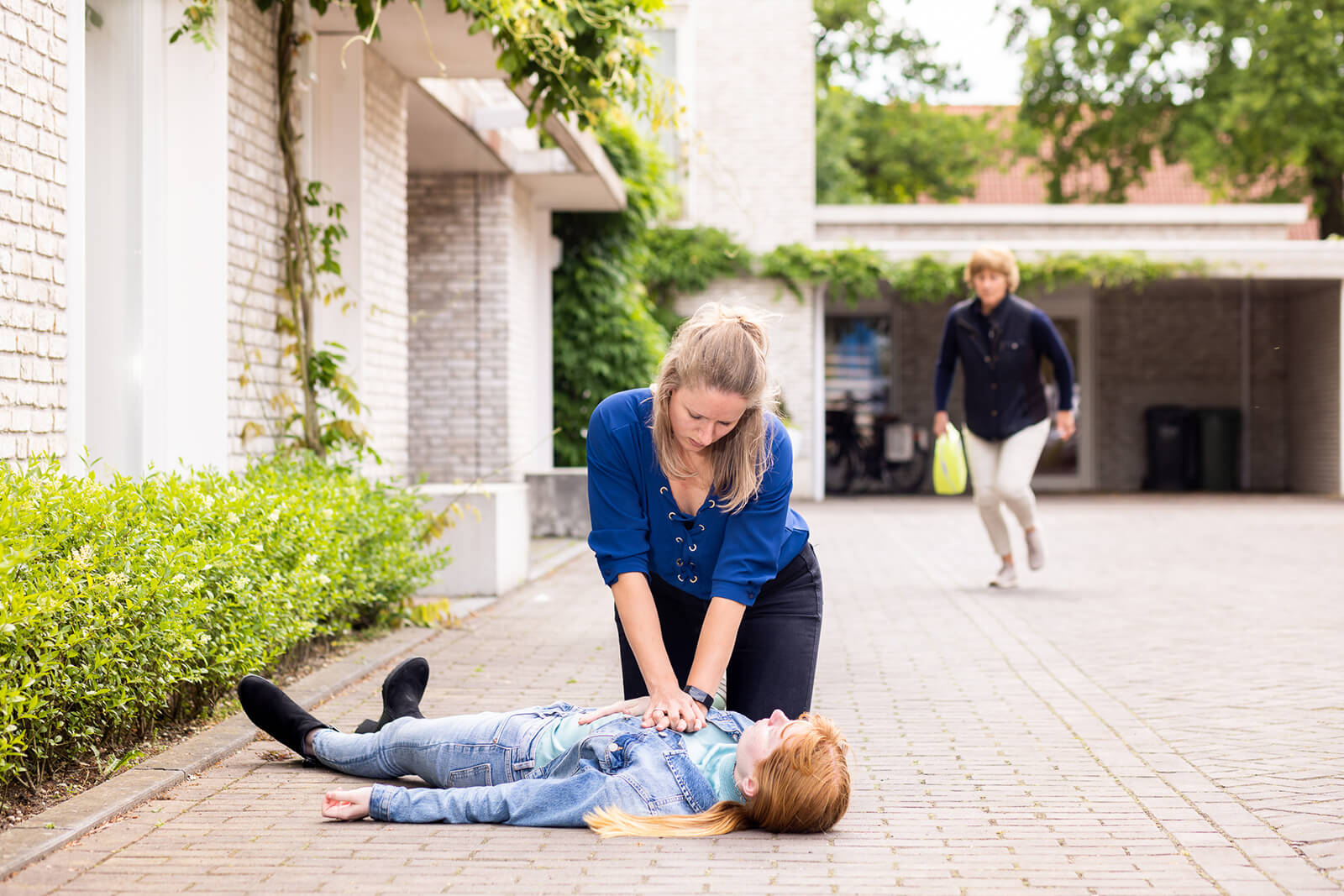
With chest compressions, the correct ‘compression rate’ is very important. If you go too slowly, blood will not reach the vital organs. If you go too fast, the heart cannot fill properly with blood. Therefore, aim for 100-120 compressions per minute. That is approximately 2 compressions per second.
Good to know: Many AEDs indicate the correct tempo with an audible signal.
With the correct ‘depth’ of chest compressions, you ensure that the heart can pump blood effectively to the vital organs. Therefore, make sure to consistently press the sternum about 5 to 6 cm.
During resuscitation, it is important to let the chest rise completely (after compression). This gives the heart the opportunity to fill with oxygen-rich blood and increases blood flow.
There are AEDs that help you with the correct tempo and depth of chest compressions through direct resuscitation feedback.
View all AEDs with direct resuscitation feedback
The chance of survival during cardiac arrest is greater if you perform continuous resuscitation. Therefore, try to take as few breaks as possible and only stop CPR when the (connected) AED asks you to or when someone else takes over the resuscitation.
Netherlands
Ekkersrijt 4301, 5692 DJ, Son
+32 (0)11 42 03 45
info@aedpartner.be
Belgium
Everselstraat 133, 3580 Beringen
+32 (0)11 42 03 45
info@aedpartner.be
© AED-Partner 2026
Our team will contact you as soon as possible for personal, no-obligation advice tailored to your situation.
 Dutch Dutch
  Dutch (Belgium)
 French
English (Belgium)
English (Netherlands)
French
English (Belgium)
English (Netherlands)